

PREFACE As engineering structures and their environments become more diverse and complex, it is not enough that the engineer be adept at applying the classical methods of structural analysis. More importantly, he must be aware of the limitations of the underlying theories and be able to make intelligent judgments about the validity of the basic assumptions. It is hoped that, by starting with a discussion of the classical theory of elasticity, this text will make clear the applicability and limitations of linear structural mechanics. The emphasis of the book is on the development and applications of work and energy methods. The principles of virtual work, complementary virtual work, and various energy theorems derived there from are used to study the behavior of linearly elastic structures. While no attempt is made to cover the many ad hoc techniques which are appropriate for special types of structures, the basic force and displacement approaches treated herein have a wide range of application and are particularly adaptable to machine computation. This book was developed from class notes used in teaching a two-term introductory course in structural mechanics at Princeton University. Portions of the notes have also been used in advanced strength-of-materials and mechanical vibration courses at the University of Kentucky. Those enrolled in the courses include juniors, seniors, and beginning graduate students from the departments of aerospace, mechanical, and civil engineering, and engineering mechanics. It is presumed that the students have had the normal undergraduate courses in engineering mechanics and have been exposed to ordinary differential equations. Following an introductory chapter, the book is divided into three parts. Part I, comprising Chapters 2 to 5, is concerned with the foundations of solid mechanics. The concepts of stress, strain, and material behavior are reviewed in Chapters 2, 3, and 4. Virtual work principles are developed in Chapter 5 and are used to derive reciprocal theorems and minimum energy principles. Exact and approximate solutions are shown for the stress and deformation distributions in several structural elements.
Part II contains four chapters dealing with the behavior of structures under stationary loads. Relatively simple, statically indeterminate beams, trusses, and frames are analyzed in Chapter 6. The conjugate force and displacement methods are formulated in matrix notation in Chapter 7, and are applied to more complicated framed and stiffened structures. The basic equations governing the noniso-thermal behavior of elastic bodies are developed in Chapter 8, and the response of structures to combined thermal and mechanical loadings are examined. Chapter 9 provides an introduction to elastic stability.
Part III of the text is concerned with the behavior of structures subject to dynamic loads. Structures which can be idealized as discrete-mass systems are considered in Chapters 10 and 11. Chapter 12 deals with the dynamic response of distributed-mass systems.
For readers who are unfamiliar with cartesian tensors, matrix algebra, or the calculus of variations, these topics are discussed in sufficient detail in Appendixes A, B, and C.
I am indebted to many students and colleagues for their valuable criticisms and suggestions. In particular I wish to acknowledge several inspiring discussions with Professor S.M. Vogel on the subject of energy principles. I also wish to thank Miss Elizabeth Thompson for her care and cheerfulness in typing and retyping the manuscript.
Finally, I am most grateful to Ann for her patience, and to Amy, Charles, Sarah, Rebecca, and Macy, who have tried to learn the art of being silent.
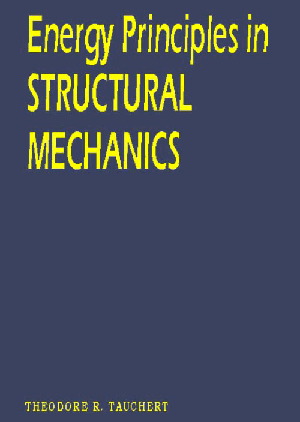
Energy Principles In Structural Mechanics
₹3,182.00
Author: Theodore R. Tauchert
Year Of Pub : 2008
Product ID: 38352o
Preface
1 Introduction
1.1 The Subject of Structural Mechanics
1.2 Classifications of Structures
1.3 Classifications of Loads
1.4 Scope of the Text
Review Problems
PART I MECHANICS OF DEFORMABLE SOLIDS
2. Analysis of Stress
2.1 Introduction
2.2 Stress at a Point
2.3 Principal Stresses
2.4 Equations of Equilibrium
Problems
References
3. Deformation
3.1 Introduction
3.2 Strain Tensor
3.3 Physical Interpretation of the Infinitesimal Strain
Tensor
3.4 Principal Strains
Problems
References
4. Material Behavior
4.1 Introduction
4.2 Experimental Observations
4.3 Generalized Hookes Law
4.4 Summary of the Equations of Elasticity
Problems
References
5 Energy Principles
5.1 Introduction
5.2 Strain Energy
5.3 Work of the External Forces
5.4 Virtual Work
5.5 Complementary Virtual Work
5.6 Reciprocal Theorems
5.7 Principle of Minimum Potential Energy
5.8 Principle of Minimum Complementary Energy
5.9 Castiglianos Theorems
5.10 Rayleigh-Ritz Method
5.11 Summary of the Energy Theorems
Problems
References
PART II STATIC BEHAVIOR OF STRUCTURES
6. Statically Indeterminate Structures
6.1 Introduction
6.2 Displacement Method
6.3 Force Method
Problems
References
7 Matrix Methods
7.1 Introduction
7.2 Flexibility and Stiffness Matrices
7.3 Matrix Displacement Method
7.4 Matrix Force Method
7.5 Summary of the Matrix Methods
Problems
References
8. Thermal Stresses and Displacements in Structures
8.1 Introduction
8.2 Thermoe1astic Behavior
8.3 Thermal Stresses and Displacements in Beams
8.4 Thermoe1astic Strain Energy and Complementary Strain Energy
8.5 Applications of the Virtual Work and Complemen- tary Virtual Work Principles
8.6 Applications of the Principles of Minimum Potential Energy and Minimum Complementary Energy
8.7 Thermal Stresses and Displacements in Indetermi- nate Structures
Problems
References
9 Structural Stability
9.1 Introduction
9.2 Stability Criteria
9.3 Equilibrium of a Beam Column
9.4 Buckling of a Pin-Ended Column
9.5 Deformation and Stability of Beam Columns
9.6 Rayleigh-Ritz Method
Problems
References
PART III DYNAMIC BEHAVIOR OF STRUCTURES
10 Structures with One Degree of Freedom
10.1 Introduction
10.2 Equation of Motion
10.3 Free Vibration
10.4 Forced Vibration
10.5 Response to a Foundation Motion
10.6 Numerical Integration
10.7 Summary
Problems
References
11. Structures with Many Degrees of Freedom
11.1 Introduction
11.2 Equations of Motiol).-Lagranges Equations
11.3 Matrix Formulation
11.4 Free, Undamped Vibration
11.5 Orthogonality Relations
11.6 Normal Coordinates
11.7 Forced Vibration
11.8 Response to a Foundation Motion
11.9 Response of a Structure with Rigid-Body Degrees of Freedom
11.10 Damped Vibration
Problems
References
12 Continuous Structures
12.1 Introduction
12.2 Equations of Motion-Hamiltons Principle
12.3 Free, Longitudinal Vibration of a Bar
12.4 Free, Lateral Vibration of a Bar
12.5 Rayleigh-Ritz Method
12.6 Forced, Longitudinal Vibration of a Bar
12.7 Forced, Lateral Vibration of a Bar
12.8 Response to a Foundation Motion
12.9 Damped Vibration
Problems
References
APPENDIXES
A Cartesian Tensors
A.l Introduction
A.2 Index Notation
A.3 Transformation of Coordinates
A.4 Tensor of First Order
A.5 Tensors of Higher Order
A.6 The Kronecker Delta and the Permutation Symbol
A.7 Tensor Operations
Problems
References
B Matrices
B.1 Introduction
B.2 Definitions and Notations
B.3 Matrix Operations
B.4 Solutions of Linear Equations
B.5 Eigenvalue Problems
Problems
References
C. Calculus of Variations
C.I Introduction
C.2 Definitions and Notations
C.3 Euler-Lagrange Equations
C.4 Natural Boundary Conditions
Problems
References
Answers to Selected Problems
Index
Related Products

Consequences Of Political Violence
₹3,626.00
Introduction To Chemistry
₹5,780.00


Reviews
There are no reviews yet.